What are literacy and mathematics statuses & how are they determined?
Last updated: July 30, 2026
For better alignment with Iowa legislation, the formula used for literacy and mathematical risk status calculations in Student Success has changed beginning with the 2026-2027 school year. The updated calculations will be applied to the spring 2026 student risk statuses and may result in the student's spring risk statuses being different from when educators viewed it last spring. The information below reflects the new risk status calculations for 2026-27.
Literacy and mathematics risk status overview
Student literacy and mathematics risk statuses for K-6 grade students are part of Iowa’s Early Literacy Implementation (ELI) and Math Counts Act and ensure identification of students in need of support, including guiding instruction and monitoring requirements.
Literacy and mathematics risk statuses are automatically calculated in Student Success three times a year when the student is screened with the district-selected default assessment during the state designated screening windows. The risk status is visible on the student’s individual profile in Student Success and exists as a filter on most reports, providing opportunities to evaluate and make decisions based on the data. Users are able to easily create groups and/or apply intervention plans based on risk status, as well as compare how students across statuses are performing relative to the healthy indicators.
Risk status calculations updated for 2026-27
The statuses are calculated for grades K-6 based on screening data. Preschool and 7-12 grade students will not have a risk status for literacy or mathematics. Risk status determinations are based on consecutive assessment scores collected during the state screening window using the district-selected default math or literacy measure for the school year at the administration location. ISASP is not incorporated into the risk status indicator formulas in Panorama Student Success. Student risk status will be one of four categories:
Adequately Progressing
At Risk
Persistently At Risk
Cannot Be Determined
Students who score below benchmark on the default assessment in two consecutive screening windows will be assigned a status of Persistently At-Risk and will remain Persistently At-Risk until they score above benchmark on the default assessment for two consecutive screening windows. Students who score above benchmark on the default assessment in two consecutive screening windows will be assigned a status of Adequately Progressing and will remain Adequately Progressing until they score below benchmark on a default assessment during the preceding screening window. Students who were previously Adequately Progressing and score below benchmark on the default assessment in a current screening window will move from a status of Adequately Progressing to At-Risk. The visual below demonstrates how a student will change risk status and requirements for each based on the designation.
When there is one missed screening window, the status from the previous window will carry forward. For example, a student with a status of At Risk in the fall that misses the winter screening window will remain At-Risk. When there are two consecutive missed screening windows, the status will change to Cannot Be Determined at the close of the window and risk status calculations will start over in the first window where data is available.
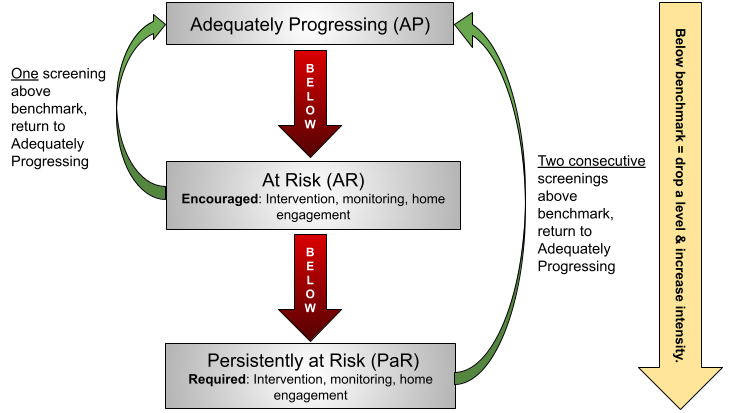
Student Success status formula vs ISASP for decision making
There may be inconsistent data between screening assessments and ISASP for some students. The use of both yearly ISASP and more frequent screening data allows for flexibility and responsiveness throughout the school year for entering and exiting students. Even with inconsistent information, it may be in the student’s best interest to move forward with the personalized reading or mathematics plan and progress monitoring to ensure the student has developed all the necessary literacy or mathematics skills. There may be cases where, for example, more recent screening data shows that last spring's ISASP may not be the most representative of current skills, or in fact, the team may be confident that ISASP scores are a better representation of need than screening data.
School teams have the flexibility and professional responsibility to be responsive to available data and attentive to student needs to best meet the instructional needs of each student. This flexibility is not a permission to focus on only preferred data, but rather latitude to efficiently use resources to effectively meet student needs.
FAQS:
Literacy and mathematics status calculations for a new student from another Iowa district
New student arrives during the screening window
If a student moves in from another Iowa district during the screening window, their literacy and mathematics status calculations will be based on your school's default screener for that grade. A score may have been collected for your school's default assessment at the student's previous school. To avoid unnecessary re-screening we recommend checking for an assessment score in Student Success. Scores do transfer between districts in Student Success, as long as the student's state ID has been entered in your district's student information system. If the student does not have a score available for your school's default assessment, screening will be needed.
New student arrives after the screening window
The student's literacy and mathematics status will be based on the default assessment for the school the student attended at the end of the screening window and will travel with the student between districts. It should be visible in Student Success after the student's state ID has been entered in your district's student information system. There is no need to screen the student on your district's default assessment upon arrival, especially if the student has data/literacy and mathematics status from the previous Iowa district. Scores collected outside of the screening window are not valid for Iowa ELI, Iowa Math Counts Act, or Healthy Indicators, and if it's more than a week or two after the screening window, often do not provide quality data for decision-making when compared to the benchmarks due to the additional instructional time the student has had since the screening window.
Literacy and mathematics statuses for 7-12 graders
Students in grades 7+ will display the risk status designation of 'Not Available' in Student Success, unless a status has been carried forward from K-6 grade.
What is a consecutive screening window
For the purpose of risk status calculation, consecutive means two screening windows in which data is collected that are separated by no more than one missed screening window. Examples:
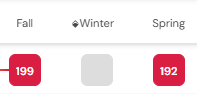
The student’s risk status in the above example will be Persistently At Risk. Fall and spring are considered ‘consecutive’ windows.
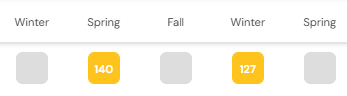
The student’s risk status in the above example will also be Persistently At Risk. Spring and winter are considered ‘consecutive’ windows.
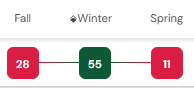
Please note that default assessments completed outside of state designated screening windows are not included in the risk status calculations. In the above example the winter screening assessment was completed outside of the state designated window and is not being included in the risk status logic. The student's risk status in the above example will also be Persistently At Risk. Fall and Spring are considered 'consecutive' windows since the score for winter was completed outside of the state designated window.
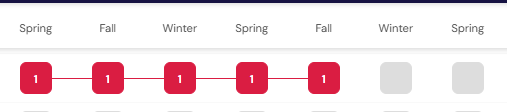
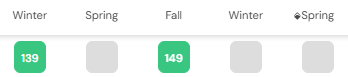
If the student has no score collected during two back-to-back windows, as in the two examples above, the student's status will be Cannot Be Determined at the close of the second window without a score. The status of Cannot Be Determined would continue until the first window where data is available, and risk status would start over based on the first available data.
I think a student's literacy or mathematics status is incorrect, what should I do?
There should be very few, if any, cases where these calculations are incorrect. Always be sure to verify the default screening assessment for your school and the date the student completed the screening assessment. Only the default assessments identified in CASA that are completed during state designated screening windows are used for populating Healthy Indicator (HI) reports and calculating student risk statuses. Assessments that are not identified as the default assessment in CASA, or default assessments completed outside of the state designated screening window, are not included in HI reports or used in risk status calculations. In all cases, err on the side of providing appropriate support to students to help the student close the gap. If you feel there is a literacy or mathematics status error, feel free to submit a question about it to support_iowa@panoramaed.com.